
The trading screens of March 2026 have been painted a deep shade of red. For many investors, seeing the Nifty 50 or S&P 500 fall alongside a sharp rise in crude oil prices feels unsettling. With Brent crude hovering near the $100 mark and geopolitical tensions in the Middle East keeping markets on edge, the key question remains:
Should you buy the dip or stay cautious?
A 1,000-point drop in the Sensex often leads to panic. But the rebound on March 24 suggests that some investors may already be looking at this phase as an opportunity. To make sense of it, it helps to step back and understand what is really driving the market.
The current volatility is closely linked to the relationship between oil prices and the broader economy.
When oil prices rise sharply, it acts like an additional cost on the system. Logistics becomes more expensive, input costs increase for companies, and margins come under pressure. Most importantly, higher oil prices push inflation higher.
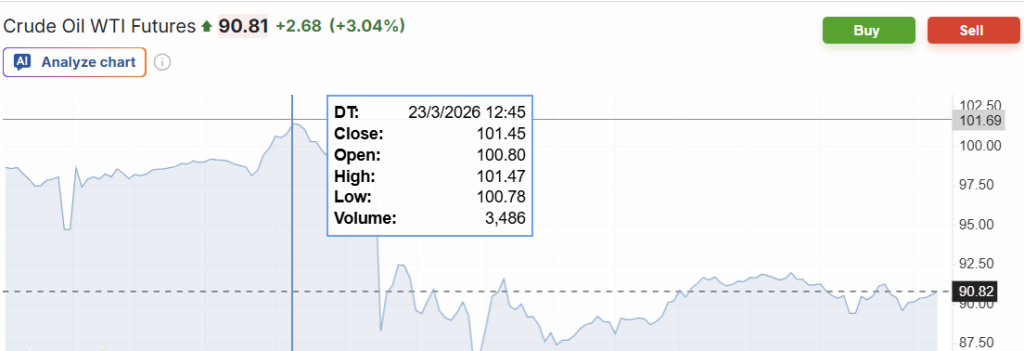
This creates a challenge for central banks. Just when markets were expecting rate cuts, rising inflation makes that difficult. As a result, the outlook shifts towards interest rates staying higher for longer.
Markets have already started pricing this in. In fact, benchmark indices corrected by nearly 8% in a single week as these concerns intensified.
Despite the negative sentiment, there are reasons why this correction may not be entirely bearish.
One key observation is the gap between earnings and prices. While stock prices have corrected by around 8–10%, earnings estimates for the next financial year have only seen a marginal downgrade of about 1.5%. This suggests that businesses are still relatively stable, even though stock prices have reacted sharply to external factors.
There are also signs of how quickly sentiment can shift. The recent 1,300-point jump in the Sensex, triggered by news of a temporary pause in strikes, highlights how markets respond to even small positive developments. Markets do not wait for complete clarity. They react as soon as the possibility of improvement appears.
History also offers some perspective. During periods of maximum uncertainty, markets have often formed a bottom. From past geopolitical events to more recent crises, investors who continued their SIPs or added quality stocks during such phases have typically seen better outcomes over the following year.
At the same time, not every correction presents an opportunity. Some areas of the market may continue to face pressure.
In a high-oil environment, certain sectors see immediate cost increases. Industries like aviation and paints are directly impacted as fuel and crude-linked inputs become more expensive. This can affect profitability in a sustained way.
There is also the risk of temporary recoveries. A short-term rally, often referred to as a “dead cat bounce”, can occur if positive news does not translate into a lasting resolution. If the current pause in tensions does not hold, markets could see renewed volatility.
Another area to watch is companies with high levels of debt. If oil prices remain elevated, bond yields may rise, increasing borrowing costs. Businesses that depend heavily on cheap debt for growth could face valuation pressure.
At a broader level, higher fuel prices can also impact consumer spending. As household expenses rise, discretionary spending tends to slow down, which can affect sectors like auto and retail.
In the current environment, a broad market approach may not work as effectively.
Some segments are better positioned. Companies in the upstream oil space tend to benefit from higher crude prices. Gold has also seen strong traction as a safe-haven asset. Defensive sectors like pharma and FMCG remain relatively stable, as demand for their products is less sensitive to economic cycles.
On the other hand, sectors heavily dependent on fuel or crude-based inputs continue to face pressure. Similarly, rate-sensitive segments could remain volatile if inflation delays any potential rate cuts.
So, is this a buying opportunity or a trap?
The answer depends largely on your investment approach.
For long-term investors, especially those investing through SIPs, staying consistent is important. Market corrections can help in accumulating investments at lower levels over time.
For those looking to invest larger amounts, a staggered approach may be more suitable. Instead of deploying all capital at once, spreading investments over time can help manage uncertainty.
For short-term traders, the current environment calls for caution. Market movements are heavily influenced by news flow, and sudden reversals are possible. Managing risk becomes critical in such phases.
The current market phase is a selective buying opportunity.
The risk lies in low-quality businesses with high debt or those directly impacted by rising input costs. The opportunity, on the other hand, lies in strong companies that have corrected due to broader market sentiment rather than any fundamental weaknesses.
In times like these, the focus should remain on quality and discipline. Companies with strong pricing power and stable business models are better equipped to handle higher oil prices.
Open Free Demat Account!
In just a few minutes, Simply provide some basic personal details, to get started.
About | Research | Pricing | Upcoming IPOs | Blog | Become a Partner | RMS Policy | Privacy Policy
Fund Transfer for Trading | Fund Transfer for DP | Client Back office/DP Login | Partner Login | Buy-Back | Margin Calculation | Re-KYC | Downloads | Platform | Loans
CIN - U65921WB1994PLC217071 | SEBI Registration No. INZ000169130 | DP SEBI Reg ID : IN-DP-533-2020 | CDSL : 1234500 | NSDL : IN303591 | Member ID`s : NSE - 08334, BSE - 912, MSEI - 18300, ICEX - 1133, MCX - 56415, NCDEX - 1286 | AMFI : ARN-12417, Date of Initial Registration: 21.10.2003, Valid Till – 21.11.2028 | APMI registered PMS Distributor, APMI APRN: 08501 | Research Analyst : INH000000206
Trinity, 226/1, A.J.C. Bose Road, 7th Floor, Kolkata - 700 020, India.
**Investments in securities market are subject to market risks, read all the related documents carefully before investing.





 ashikawealth.in